

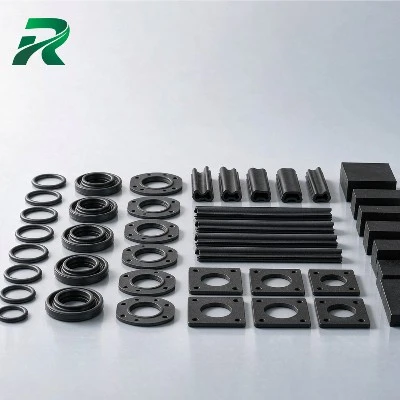
Industrial seals are key components used to prevent fluid (liquid or gas) leakage in mechanical systems and are widely used in hydraulics, pneumatics, chemical engineering, aerospace, and other fields.Their core function is to create a reliable barrier between dynamic or static contact surfaces through physical or chemical interactions, ensuring the stability of system pressure, temperature, and media. The working principle of industrial seals involves multidisciplinary knowledge, including materials science, fluid mechanics, and mechanical design. Their effectiveness depends on the compatibility of seal structure, material properties, and operating conditions.
Basic Sealing Mechanisms
The working principles of industrial seals are primarily based on two mechanisms: contact sealing and non-contact sealing. Contact sealing creates frictional resistance through direct contact between the seal and the mating surface, preventing leakage. They are commonly used in dynamic (such as rotating shaft sealing) and static (such as flange connections) scenarios. Non-contact sealing relies on gap control or fluid dynamic effects (such as labyrinth seals and spiral seals), leveraging the fluid's inherent viscosity or flow resistance to achieve sealing. They are suitable for high-speed or high-temperature environments.
Working Principles of Contact Seals
The core of contact sealing is surface pressure and material deformation. When seals (such as O-rings and lip seals) are compressed, they deform elastically or plastically, conforming tightly to mating surfaces and filling microscopic gaps, thereby blocking leakage paths. For example, in hydraulic systems, O-rings generate contact stress through radial compression, which must exceed the system pressure to effectively seal. Furthermore, the friction coefficient, wear resistance, and extrusion resistance of the sealing material directly impact its long-term reliability.
How Non-Contact Seals Work
Non-contact seals achieve sealing through gap control or fluid dynamics. For example, labyrinth seals use a series of staggered tooth-groove structures to cause leaking fluid to change direction multiple times during flow, resulting in energy loss and ultimately reducing pressure to negligible levels. Spiral seals utilize the pumping effect created by spiral grooves on a rotating shaft to push leaking fluid back toward the high-pressure side. These seals eliminate the need for direct contact and are therefore suitable for high-speed environments or corrosive media, but they generally require high machining precision.
Key Factors Affecting Sealing Performance
The effectiveness of industrial seals is influenced by a variety of factors, including:
1. Material Properties: The sealing material must possess corrosion resistance, a high elastic modulus, and appropriate hardness (e.g., nitrile rubber for oil resistance, and polytetrafluoroethylene for high-temperature chemical resistance).
2. Operating Conditions: Pressure, temperature, speed, and media type (e.g., water, oil, gas) directly influence seal selection and design. For example, high-pressure environments require spiral wound gaskets, while high-temperature steam systems may opt for graphite seals.
3. Surface Quality: The roughness and flatness of the mating surfaces determine the uniformity of the sealing contact. Rough surfaces can lead to localized leakage or premature wear.
Differences Between Dynamic and Static Seals
•Dynamic seals (e.g., rotating shaft seals and reciprocating rod seals) require a balance between sealing performance and frictional loss. Common solutions include lip seals (which utilize an elastic lip to follow the deformation of the moving surface) and mechanical seals (which achieve high-pressure sealing through the end faces of a rotating ring and a stationary ring).
•Static seals (such as flanges and threaded connections) prioritize material compression and rebound properties, typically employing gaskets (e.g., metal gaskets, non-asbestos sheets) or directly molded seals (e.g., injection-molded O-rings).
Industrial seals essentially operate by blocking leakage paths under specific operating conditions through material deformation, contact pressure, or fluid dynamics. Optimizing their performance requires a comprehensive consideration of materials science, mechanical design, and engineering practices to ensure equipment safety, efficiency, and longevity. With the advancement of industrial technology, new sealing materials (e.g., nanocomposites) and intelligent sealing technologies (e.g., integrated leak detection) are driving the sealing industry toward greater reliability and adaptability.


