

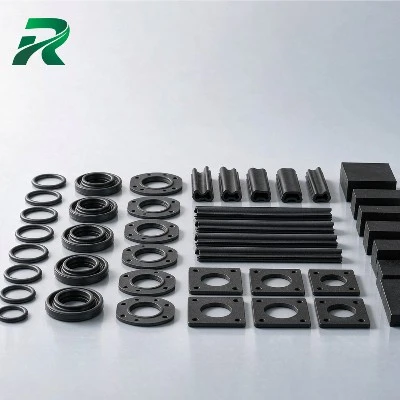
In the modern automotive industry, rubber parts often play a supporting role, yet they fulfill irreplaceable, critical functions. These components, made from synthetic or natural rubber, leverage the deep integration of materials science and engineering technologies to continuously provide core assurance for vehicle safety, comfort, and durability.
From a technical perspective, rubber products exhibit unique performance advantages. Their superior elastic modulus can absorb up to 90% of mechanical vibration energy, enabling components like engine mounts and shock absorber bushings to effectively filter the impact of road bumps and power transmission. For example, tires treated with nano-carbon black reinforced rubber composites can maintain grip while reducing rolling resistance by 15%-20%, directly contributing to improved fuel economy. Fluorosilicone rubber products in sealing systems can maintain stable airtightness in extreme temperatures ranging from -60°C to 250°C, which is crucial for protecting battery packs in new energy vehicles.
From an economic perspective, the global automotive rubber parts market has exceeded US$80 billion, accounting for 6%-8% of vehicle manufacturing costs. The average passenger car is equipped with over 200 rubber components, weighing approximately 25 kilograms. Lightweight improvements to the transmission dust cover alone save the industry over 120,000 tons of metal annually. Of greater strategic significance, the R&D cycle for high-performance rubber formulas has been shortened to 18 months, and the material recycling rate has increased to 92%. This synergistic development of technological iteration and the circular economy is driving the industry's transition to green manufacturing.
Amid the wave of intelligentization, rubber products are undergoing functional innovation. Smart tires with integrated pressure sensors can monitor tire pressure changes in real time, and the use of conductive rubber in anti-static flooring improves the reliability of autonomous driving systems. These technological breakthroughs not only maintain the fundamental value of rubber materials but also give them a new dimension of data interaction, transforming traditional accessories into key nodes in the automotive intelligent ecosystem.
The value of automotive rubber accessories is fundamentally the result of the fusion of materials science, mechanical engineering, and market demand. From basic protection to intelligent integration, these seemingly ordinary rubber components have always been a vital vehicle for automotive technological advancement, silently supporting the safe operation of the modern transportation system.


