

As an indispensable component in automotive manufacturing, automotive rubber parts are widely used in key areas such as sealing, shock absorption, transmission, and protection.However, rubber parts for different applications vary significantly in terms of material selection, structural design, performance requirements, and production processes. This article will explore the key differences among automotive rubber parts from multiple perspectives to help understand their functional characteristics and applicable scenarios.
Material Selection Differences
One of the core differences among automotive rubber parts lies in the rubber base material used. Common rubber types include natural rubber (NR), styrene-butadiene rubber (SBR), chloroprene rubber (CR), ethylene-propylene rubber (EPDM), silicone rubber (VMQ), and fluororubber (FKM). Different rubber materials have unique physical and chemical properties, making them suitable for different operating environments. For example:
•EPDM (ethylene-propylene rubber) offers excellent heat, ozone, and weather resistance, and is commonly used in components exposed to outdoor environments, such as automotive door and window seals and radiator hoses.
•Silicone rubber (VMQ) offers outstanding high-temperature resistance, maintaining elasticity in temperatures ranging from -60°C to 250°C, making it suitable for seals in high-temperature areas of the engine compartment.
•Fluorocarbon rubber (FKM) offers excellent oil and chemical resistance and is primarily used in seals exposed to oily media, such as fuel systems and transmissions.
In contrast, common rubbers such as natural rubber (NR), while offering excellent elasticity, exhibit poor aging resistance and are typically used only in components with lower durability requirements, such as interior shock absorbers.
The Difference Between Function and Structural Design
The function of automotive rubber parts determines their structural design. Based on their intended use, rubber parts can be divided into the following categories:
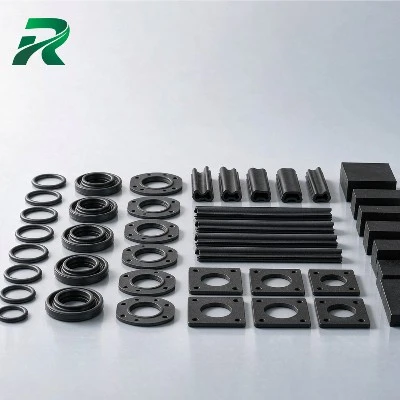
1.Sealing Parts (such as oil seals, O-rings, and door seals)
•The primary function is to prevent liquid or gas leakage and to block external contaminants such as dust and moisture.
•The structure typically has a precise geometric shape, such as the circular cross-section of an O-ring or the metal skeleton and rubber sheathing composite structure of an oil seal.
2.Shock-absorbing accessories (such as rubber bushings and suspension shock absorbers)
•Used to absorb vibration and shock, improve driving comfort, and protect other components.
•Design emphasizes the hardness and damping properties of rubber, often using a multi-layer composite structure to optimize mechanical properties.
3.Transmission accessories (such as timing belts and rubber tracks)
•Responsible for power transmission, requiring high wear resistance and tensile strength.
•Often incorporate fiber or steel wire reinforcement to enhance durability.
4.Protective accessories (such as dust covers and bump stops)
•Mainly used to protect other components from mechanical damage or environmental corrosion.
•Relatively simple in structure, but requires good flexibility and tear resistance.
Different performance requirements
Different application scenarios place varying demands on the performance of rubber accessories, primarily in the following areas:
•Temperature resistance: Engine compartment components must withstand temperatures exceeding 150°C, while winter weatherstrips must maintain elasticity at temperatures as low as -40°C.
•Oil resistance: Fuel system components must withstand long-term corrosion from gasoline and engine oil, so fluororubber or hydrogenated nitrile rubber (HNBR) is often used.
•Aging resistance: Components exposed to UV rays and ozone (such as roof seals) require the addition of an anti-aging agent to extend their service life.
•Compression set: Seals should minimize deformation after prolonged compression to ensure continued effective sealing performance.
Differences in production processes: The manufacturing processes for rubber components vary depending on their intended use and primarily include:
•Compression molding: Suitable for mass-produced standard parts such as O-rings and small seals, molded in a single step using a vulcanization mold.
•Extrusion: Used for the continuous production of long, rectangular components such as rubber hoses and seals, which may require a subsequent secondary vulcanization process.
•Injection molding: Suitable for complex, precision components such as oil seals with metal inserts, ensuring high dimensional accuracy.
•Handmade Customization: Certain rubber parts for special applications (such as high-performance shock absorbers for racing cars) may require manual finishing or specialized vulcanization processes.
Automotive rubber parts differ in many aspects, including materials, functions, performance, and production processes. The proper selection and design of rubber parts can significantly enhance vehicle reliability, safety, and comfort. With the continuous development of the automotive industry, the requirements for rubber parts are also increasing. The use of high-performance, environmentally friendly rubber materials will become an industry trend in the future.


