

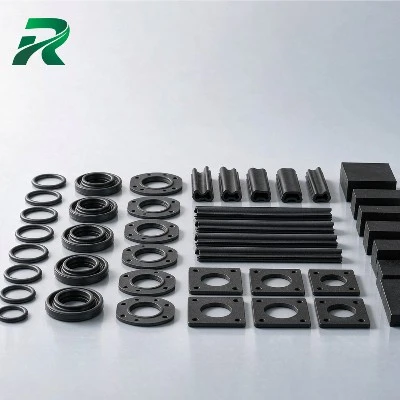
Industrial seals are essential components of mechanical equipment, and their performance directly impacts the reliability and safety of the equipment. The molding process is a key factor in determining seal quality, with different methods directly affecting the material's density, dimensional accuracy, and service life.
Currently, industrial seals are primarily manufactured using compression molding, injection molding, extrusion, and calendaring. Compression molding is the most traditional and widely used method, suitable for thermoset materials such as rubber and polyurethane. The process involves preforming the material, heating and pressurizing the mold, and cooling and demolding. It allows for precise control of the seal's geometry and structural strength, making it particularly suitable for the production of small and medium-sized seals with complex structures. Injection molding is more suitable for large-scale production. The material is melted at high temperature and injected into a mold under high pressure, then cooled and formed. While highly efficient, it requires strict control of temperature and pressure parameters to prevent defects. For continuous-length seals, such as sealing strips or hoses, extrusion is more efficient. The material is forced through a screw through a specific mold to form a continuous cross-section, which is then vulcanized or cooled to set the shape. Calendering is used to produce thin sheets of sealing material, using rollers to create a uniform thickness. This process is commonly used in gasket-type seals.
In recent years, 3D printing technology has been increasingly used for rapid prototyping of customized seals, but its material properties and durability still require further optimization. Regardless of the process used, rigorous mold design, material selection, and process control are key to ensuring seal performance. In the future, with advances in materials science and manufacturing technology, the molding process for industrial seals will become more efficient and precise, meeting the stringent sealing performance requirements of high-end equipment.


