


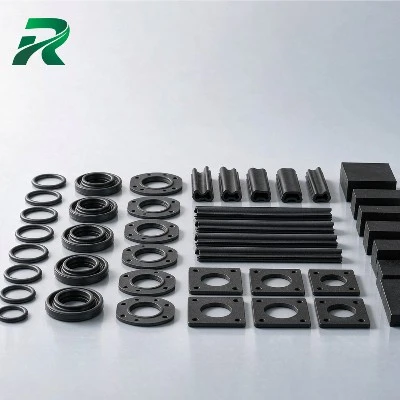
Rubber profiles, as polymer materials widely used in industrial and civilian applications, have a performance and quality that directly impacts equipment reliability, structural safety, and the lifespan of end products. To ensure the functionality, durability, and safety of rubber profiles in various application scenarios, a series of standardized technical specifications and testing requirements have been established globally. This article will systematically explain the framework and practical value of rubber profile implementation standards from the perspectives of implementation standard classification, core indicators, testing methods, and industry applications.
Classification and Scope of Application of Rubber Profile Implementation Standards
Implementation standards for rubber profiles are generally categorized based on material type, usage environment, and functional requirements. They can be divided into four levels: international standards, national standards, industry standards, and enterprise standards. Internationally, a series of standards published by the International Organization for Standardization (ISO), such as ISO 3601, Rubber Seals for Fluid Systems, and ISO 815, Rubber Compression Set Test Methods, provide a common technical framework for rubber products worldwide. Regional standards, such as the EU's EN standards (such as EN 549, Flame-Resistant Rubber Parts for Gas Equipment) and the US's ASTM standards (such as ASTM D2000, Classification of Rubber Materials for Automotive Use), refine performance parameters to meet the technical requirements of specific markets.
At the national level, China's current rubber profile standards are dominated by GB (national standard) and HG (chemical industry standard). For example, GB/T 5574-2008 "Industrial Rubber Sheet" specifies the thickness tolerance, hardness range, and mechanical property requirements for general-purpose rubber sheet materials; GB/T 13477-2002 "Test Methods for Building Sealing Materials" establishes specialized testing procedures for the tensile strength, tear strength, and aging resistance of building rubber sealing strips; and HG/T 3099-2011 "Industrial Rubber Sheet," for the chemical industry, further refines the formulation design and performance thresholds for rubber profiles under different operating conditions (such as oil resistance, acid and alkali resistance). Furthermore, for specialized sectors (such as rail transit and aerospace), the industry will develop even more stringent enterprise or group standards to meet reliability requirements in extreme environments.
Core Technical Indicators of Rubber Profile Implementation Standards
The performance evaluation of rubber profiles requires multi-dimensional key technical indicators, which directly determine their suitability for practical applications. Physical and Mechanical Properties
Physical and mechanical properties are fundamental indicators of rubber profiles, including hardness (Shore A hardness typically ranges from 40-90), tensile strength (generally ≥5 MPa, with high-performance products reaching over 20 MPa), elongation at break (≥200% for standard rubber, over 500% for high-elastic materials), and compression set (≤20% for high-quality products at 70°C for 24 hours). For example, GB/T 12828-2006, "Rubber Parts for High-Elasticity Rubber Couplings," specifies that rubber profiles used in transmission systems must possess a tensile strength of ≥15 MPa and a compression set of ≤15% to ensure stable torque transmission during long-term operation.
Environmental Resistance
Rubber profiles are often exposed to complex environments such as high and low temperatures, oils, ozone, and UV rays, making environmental resistance a key assessment factor. Heat resistance is assessed through a hot air aging test (e.g., tensile strength retention ≥ 80% after 72 hours at 70°C); cold resistance is assessed using the brittle temperature (no cracking at -40°C); oil resistance is assessed based on GB/T 1690-2010, "Test Methods for Resistance of Vulcanized or Thermoplastic Rubber to Liquids," by testing the volume expansion in hydraulic and lubricating oils (generally controlled to ≤ 20%). Ozone resistance is verified through an ozone aging chamber test (no cracking after 50 hours at 50 pphm, 40°C, and 20% tension).
Functional Indicators
For specific applications, rubber profiles must also meet specific functional requirements. For example, sealing profiles require special attention to compression rebound (≥60% to ensure seal durability) and surface roughness (Ra ≤ 3.2μm to improve adhesion); conductive rubber requires controlled volume resistivity (≤10³Ω·cm to eliminate static electricity); and flame-retardant rubber must pass UL 94 or GB/T 10707-2008 testing (achieving a V-0 flame retardancy rating).
Testing Methods and Quality Control for Rubber Profiles
To ensure that rubber profiles meet compliance standards, standardized testing procedures and specialized equipment are required. Routine testing includes:
•Dimensional Accuracy: Thickness, width, and shape deviation are measured using vernier calipers and micrometers (e.g., GB/T 5723-2018 stipulates a thickness tolerance of ≤±0.5mm for rubber sheets);
•Mechanical Properties: Tensile strength and tear strength are tested using a universal materials testing machine (referring to GB/T 528-2009);
•Aging Performance: Long-term environmental exposure is simulated using a heat aging chamber and an ozone aging chamber (according to GB/T 3512-2014);
•Composition Analysis: Compliance between the rubber base material and additive ratios is verified using a FTIR spectrometer or thermogravimetric analyzer (TGA).
Manufacturers must establish a comprehensive quality management system, from raw material procurement (e.g., supplier qualification review of raw rubber, vulcanizers, and fillers), to production process control (precise control of vulcanization temperature, time, and pressure), to finished product delivery inspection (full inspection or a combination of random inspections). The involvement of third-party testing organizations (such as SGS and Huachuang Testing) can further enhance the credibility of standard implementation and ensure that products comply with contractual agreements and international trade requirements.
The Role of Implementation Standards in Driving Industry Development
The improvement and implementation of implementation standards for rubber profiles not only ensures product quality and safety, but also promotes the iteration and upgrading of industry technology. On the one hand, standardization reduces communication costs across the industry chain and promotes the large-scale application of rubber products (for example, after standardization of building sealing strips, procurement efficiency for door and window manufacturers increased by over 30%). On the other hand, high standards compel companies to increase R&D investment. For example, to meet the high-temperature resistance (above 150°C) and electrolyte corrosion resistance requirements of new energy vehicle battery pack seals, domestic companies have developed fluorosilicone rubber composite profiles, breaking the monopoly of foreign technology.
Furthermore, with the strengthening of environmental regulations (such as the EU REACH regulation's restrictions on polycyclic aromatic hydrocarbons in rubber), implementation standards are gradually incorporating green indicators (such as heavy metal content and volatile organic compound emissions), guiding the industry's transition towards sustainability.
Rubber profile implementation standards are the critical link between material performance, engineering requirements, and market regulations. From basic physical properties to extreme environmental adaptability, and from general-purpose products to specialized functional components, the continuous improvement of the standardization system provides solid support for rubber profile quality control, technological innovation, and industrial upgrading. In the future, with the emergence of new materials and processes, rubber profile implementation standards will continue to be dynamically optimized to accommodate a wider range of application scenarios and higher technical requirements, safeguarding the safe and reliable operation of industrial manufacturing and public welfare projects.


