
Rubber Compression Set: The Key Metric to Evaluate Seal Service Life
When you select rubber seals for valves, hydraulic cylinders, pipe joints, automotive assemblies or outdoor equipment, many buyers only focus on hardness, material grade and temperature resistance. However, one hidden parameter largely decides whether your seal will leak after months or years of continuous service: compression set.
Compression set is one of the most fundamental and reliable indicators for judging the elastic recovery ability of rubber materials. For sealing products, excellent resilience directly equals stable sealing performance.
What Is Rubber Compression Set?
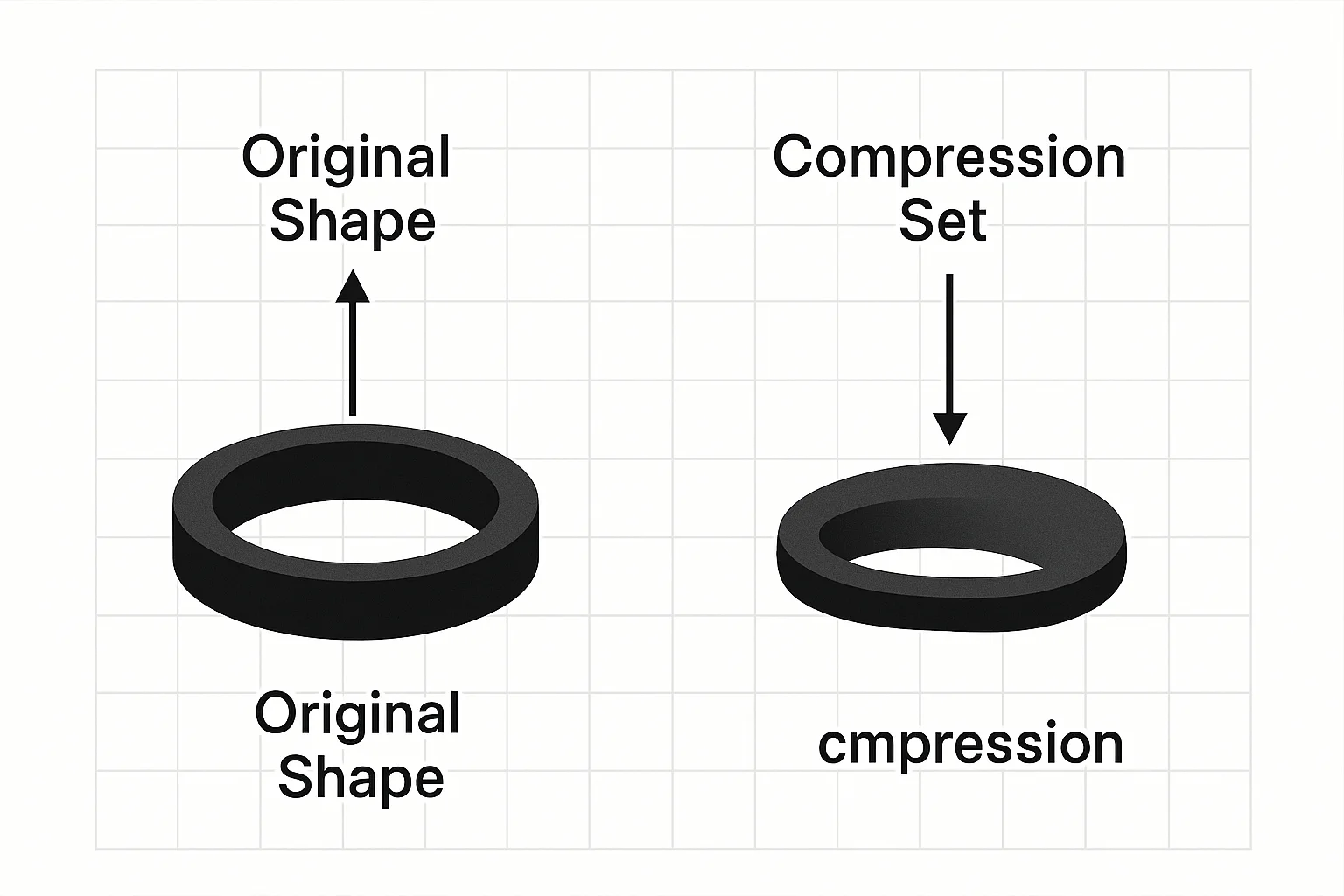
Compression set describes the permanent deformation that remains on a rubber sample after it has been compressed for a specified time under fixed temperature, then released and cooled down.
The test follows standard procedures such as ASTM D395 or ISO 815. A rubber specimen is squeezed to a certain compression ratio (commonly 25%) in a fixture, held at target temperature for a set duration, then taken out. After cooling, the residual thickness loss is calculated as a percentage.
Compression Set (%) = [(Original thickness − Thickness after recovery) ÷ (Original thickness − Thickness under compression)] × 100%
Lower compression set value = Better elastic recovery.
- A low compression set means the rubber can bounce back close to its original shape after long squeezing. The sealing contact pressure stays consistent, and leakage risk stays low.
- A high compression set means the rubber suffers permanent "flattening". It cannot spring back, loses sealing pressure, and leakage occurs.
Why Compression Set Matters Most for Seals
Seals work under sustained compression all the time. Once installed between two mating surfaces, the rubber is continuously pressed.
Over time, heat, pressure, oil, ozone and chemical media accelerate material aging. If the rubber has poor compression set resistance:
Permanent deformation appears;
The contact stress between seal and groove drops;
Gaps form at the sealing interface;
Medium leakage starts, which leads to equipment downtime, fluid loss or safety hazards.
This is why two rubber seals with the same Shore hardness can perform totally differently in the field. Hardness tells you how firm the rubber is. Compression set tells you how long it can keep sealing.

Typical Compression Set Reference for Common Rubber Materials
Here is a practical reference for your material selection (test condition: 25% compression, 70h aging):
- Nitrile rubber (NBR): Good for oil resistance, moderate compression set; ideal for general hydraulic and oil seals
- Fluoro rubber (FKM / Viton): Excellent heat and chemical resistance, low compression set at high temperature; preferred for high-temperature, corrosive fluid working conditions
- EPDM: Outstanding hot water, steam and ozone resistance; stable compression set for water, pipeline and outdoor sealing
- Silicone rubber (VMQ): Wide temperature range; suitable for low-pressure, high-temperature dry environment sealing
Important note: Compression set results change dramatically with test temperature. A material with good value at room temperature may show poor performance at 150°C. Always check the test temperature matching your actual working condition.
Practical Guidance for Buyers & Engineers
Do not only check material type. Always ask suppliers for compression set test reports under your real operating temperature and duration.
High temperature service demands stricter compression set requirements. For engine, steam and high-temperature hydraulic systems, prioritize FKM or specially formulated EPDM.
Groove design cooperates with compression performance. Too high squeeze rate will speed up permanent deformation, even for premium rubber compounds.
Storage condition also affects final performance. Long-term improper storage, excessive stacking pressure and UV exposure will degrade rubber elasticity in advance.
Final Takeaway
Rubber seals fail not only because of corrosion or tearing. More often, failure comes from gradual loss of elasticity - measured by compression set.
If you need sealing parts that maintain stable performance over thousands of working hours, compression set should be on the top of your checklist when reviewing material datasheets.
As a custom rubber manufacturer, we can adjust rubber formulations to target specified compression set requirements, and provide full test certificates for your sealing projects. Contact us to discuss your working conditions and get suitable material recommendations.
FAQ
Q: What is a good compression set value for rubber seals?
A: In general, below 20% is considered good for most sealing applications. For critical high-temperature sealing, customers usually require compression set below 10%.
Q: Is compression set the same as hardness?
A: No. Hardness measures surface resistance to indentation. Compression set measures permanent deformation after long compression. They are independent indicators.