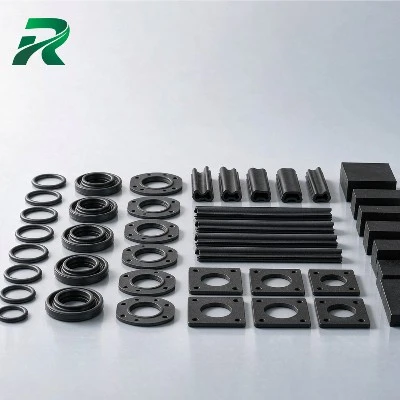

When sourcing industrial rubber components, selecting the right manufacturing process directly affects your part design, dimensional tolerance, cost and delivery timeline. Many buyers struggle to tell the difference between rubber compression molding and extrusion. As a professional rubber manufacturer, we break down the two core processes, their advantages, limitations and suitable applications to help you make the right decision.
What is Rubber Compression Molding?
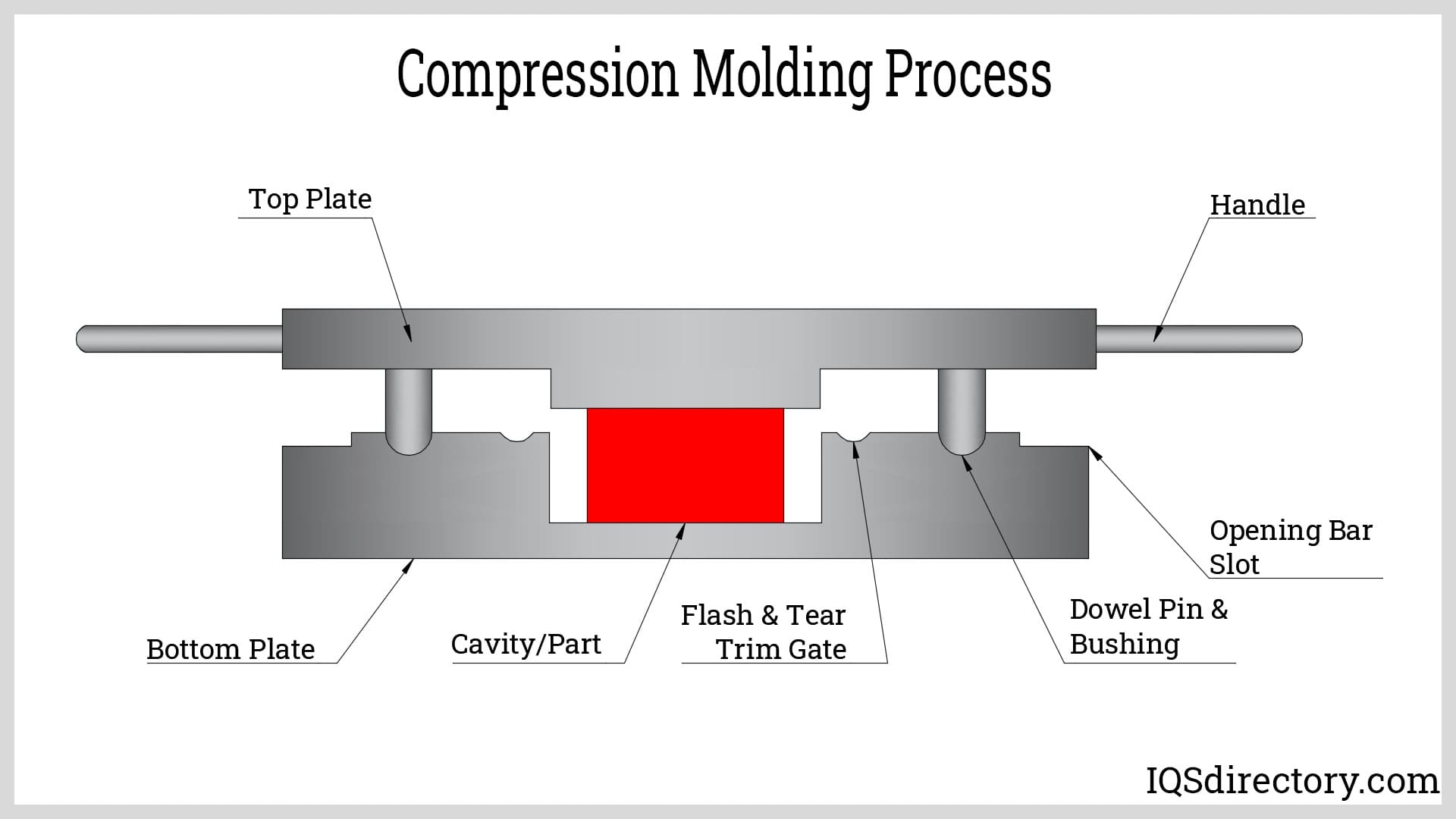
Rubber compression molding is a classic molding process for custom rubber parts. Pre-measured raw rubber compound is placed into a heated metal mold cavity. The mold is closed under high pressure and heat, the rubber material flows and fills the whole cavity, and vulcanizes to form the final shape.
Advantages of Compression Molding
- Supports complex 2D & 3D geometries, holes, grooves, curved surfaces and irregular shapes.
- Good dimensional accuracy, suitable for parts with tight tolerance requirements.
- Works well with nearly all rubber materials: NBR, EPDM, FKM, CR, NR, silicone rubber.
- Ideal for medium and small batch custom orders, flexible for custom designs.
Limitations
- Longer cycle time per piece, higher mold cost for complex molds.
- Manual trimming of flash is usually required, which adds production time.
- Not the most cost-effective choice for simple continuous long profiles.
Typical Products for Compression Molding
- Rubber gaskets, sealing rings, vibration mounts, rubber bumpers
- Custom rubber pads, rubber bushings, rubber diaphragms
- Special-shaped rubber parts for machinery, mining, automotive and pipeline systems

What is Rubber Extrusion Process?
Rubber extrusion is a continuous production method. Raw rubber compound is forced through a shaped die under pressure inside an extruder machine. The extruded continuous profile then goes through vulcanization to fix its shape.
Advantages of Extrusion
- Continuous high-speed production, low unit cost for long profiles.
- Short production cycle, perfect for mass volume orders.
- Simple die structure, low tooling cost compared with complex compression molds.
Limitations
- Only produces constant cross-section profiles; cannot make complex 3D structures.
- Dimensional tolerance is looser than molded rubber parts.
- Extra cutting or secondary processing is needed to get finished lengths.
Typical Products for Extrusion
- Rubber strips, rubber cords, extruded sealing profiles
- Round rubber tubes, rectangular rubber hoses, edge trim strips
- Continuous weather seals for doors, windows and equipment
Side-by-Side Comparison Table
| Item | Rubber Compression Molding | Rubber Extrusion |
|---|---|---|
| Product Shape | Complex 3D shapes, irregular parts | Constant cross-section long profiles |
| Tolerance | Tighter dimensional tolerance | Relatively loose tolerance |
| Tooling Cost | Higher for complex molds | Low die cost |
| Production Speed | Slow, batch production | Fast, continuous mass production |
| Suitable Batch | Small & medium custom runs | Large volume orders |
| Material | NBR, EPDM, FKM, CR, NR, Silicone | Most common rubber compounds |

-
Check your product shapeIf your part has holes, uneven thickness, curved 3D structure, choose compression molding. If it is a long strip, tube or profile with unchanged cross-section, extrusion is the better option.
-
Check order quantityFor prototype, small batch or custom one-off parts, compression molding is more flexible. If you need large-volume continuous profiles, extrusion reduces unit cost greatly.
-
Check tolerance and sealing requirements
High-precision sealing components, anti-vibration pads require compression molding. Non-critical long sealing strips can use extrusion.
-
Check budget
Extrusion has lower tooling cost and cheaper unit price for bulk orders. Compression molding needs mold investment, but unlocks unlimited custom geometry.
Final Notes
Many projects also combine both processes: extruded rubber profiles can be cut and then compression molded for end forming.
If you are unsure which manufacturing technology fits your rubber parts, send us your drawings or samples. As a direct rubber source factory, we can evaluate your project, recommend the optimal process and provide quotation accordingly.
Call to Action
Get your custom rubber solution today. Contact our engineering team for technical consultation and quotation.